Showing posts with label chemistry. Show all posts

Friday, September 14, 2012

Bubble Bomb


Materials:
l  water
l  measuring cup
l  zipper-lock plastic bags
l  paper towel
l  tablespoon
l  baking soda
l  vinegar


Procedures:
Step 1- Figure out where you want to explode your Bubble Bomb. Sometimes the bags make a mess when they pop, so you may want to experiment outside.

Step 2- Tear a paper towel into a square that measures about 5 inches by 5 inches. Put 1 1/2 tablespoons of baking soda in the center of the square, then fold the square as shown in the picture, with the baking soda inside.
Step 3- Pour into your plastic bag:
l  1/2 cup of vinegar
l  1/4 cup of warm water


Step 4- You need to drop the baking soda (in the paper towel) into the vinegar and zip the bag closed before the fizzing gets out of control.


Step 5- Shake the bag a little and stay away from it!!!


Friday, September 7, 2012

Color Changing Milk


Color Changing Milk

Time: takes around 5 minutes

Cost: around $5~6
Materials:


- Milk (whole)

- Dinner plate

- Food coloring (red, yellow, green, blue)

- Dish-washing soap (Dawn brand works well)

- Cotton swabs


Area of Topic : Chemistry

Learning Objectives:

  Students can learn about chemical reaction.

 Procedure
1. Pour some milk in the dinner plate.


2. After pouring some milk, add one drop of each of the four colors of food coloring in the center- red, yellow, blue, and green.


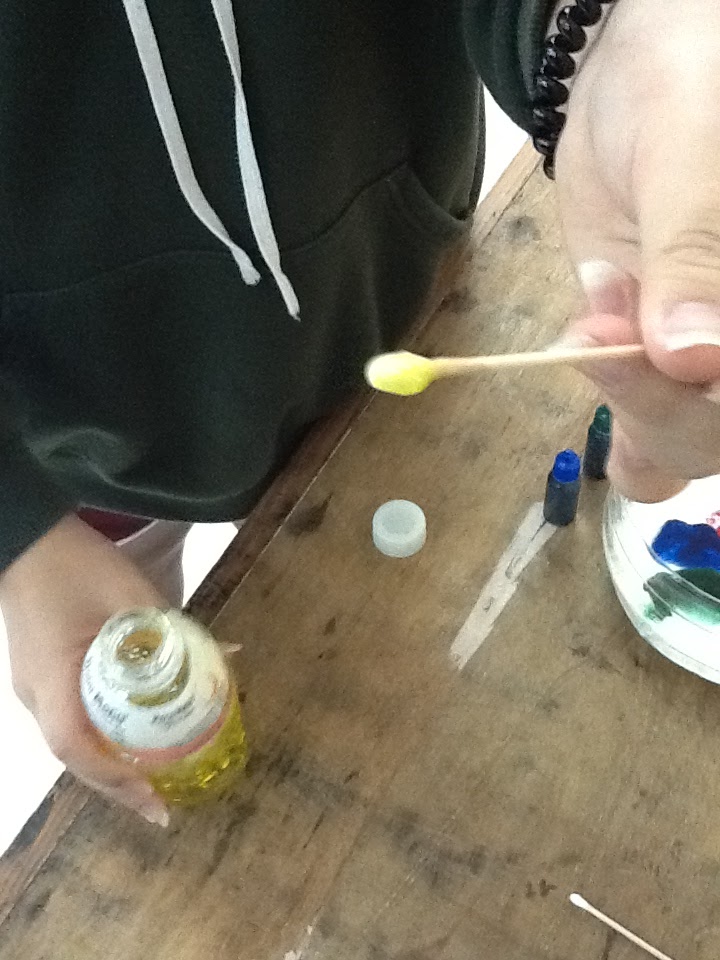
3. Put drop of liquid dish soap on the tip of the cotton swab.

4 And touch the surface of the milk (in the middle) with the cotton swab and hold it there for 10 seconds and see what it happens.


Explanation:

How does it work?
Milk is mostly water but it also contains vitamins, minerals, proteins, and tiny droplets of fat suspended in solution. As fats and proteins are sensitive to changes in the surrounding solution when it adds the soap, it weakens chemical bonds that hold the proteins in solution are altered. Therefore, the food color molecules are bumped and shoved everywhere.
There's another reason the colors explode the way they do.


Wednesday, January 25, 2012

Can You Pour a Gas?

★ Do you believe that you can pour gas?


★Time: about 5minutes (set up and cleaning included)


★Cost: $0 (if you have all the materials in the house)

★Area of Science: General Science / Chemistry

★Learning Objectives: Students can learn differences in density of gas.

★Materials :
1. Candle
2. Match
3. Cups
4. Baking soda
5. Vinegar

★Procedure:
1. Light a candle
2. Put some baking soda in a cup
3. Pour some vinegar in the same cup
4. Wait for about three to five seconds and pour the gas formed in the cup on to another cup.
5. It may look awkward, but trust me
6. Make sure that the baking soda and vinegar mixture do not get poured as well.
7. Now pour the gas in the new cup on the candle.
8. See what happens!


★Why does this happen? This is because when baking soda is mixed with vinegar, carbondioxide is produced. Since carbondioxide is heavier(denser) than the air, it tends to stay down. That is the reason why we can pour the gas. The fire goes off, because oxygen is needed in combustion. When there is only carbondioxide, the fire will be extinguished.

★Tips on the experiment
1. Do not use too much of vinegar and baking soda.
2. Do not let the kids be near the fire.
3. Do the experiment inside the house for the wind will blow the carbon dioxide away.